Business-Aware Content, Custom Link Pages, and Workspace Controls
Get the newsletter
What shipped and what we're learning building Ballad, in your inbox. Unsubscribe any time.
What shipped
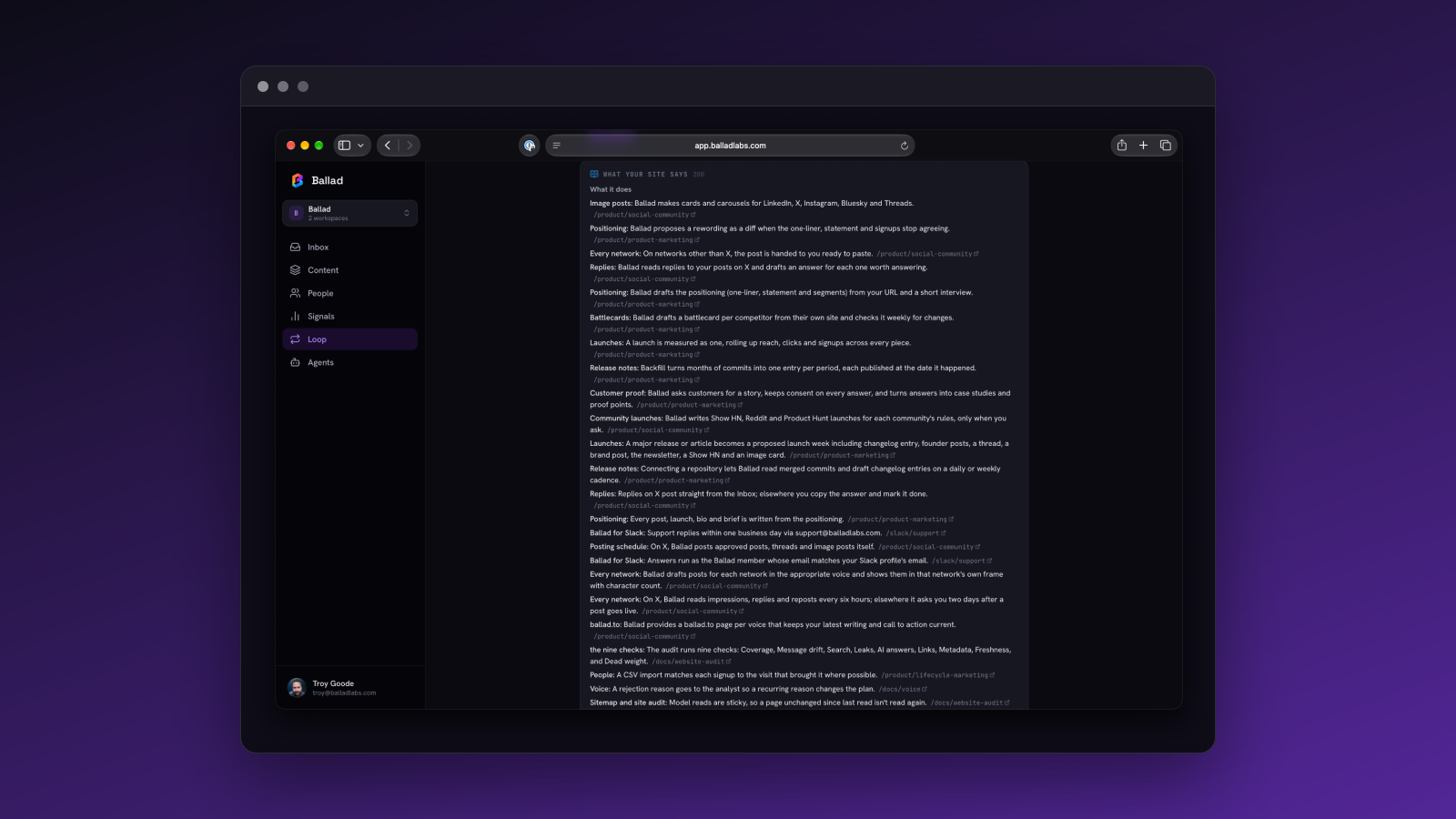
For a while, Ballad assumed every business it talked to sold software. That's a bad assumption for a lot of founders. Now Ballad asks what kind of business you run and how it makes money, and it changes what it does based on the answer. On top of that, this release also lets you customize your Link Page and gives workspaces more control over members and appearance.
Business-aware content
- Ballad asks what kind of business you run and how it makes money during setup.
- Services firms get a practice-focused read of their site instead of a product-focused one.
- Competitor comparisons are built on work and outcomes, not pricing plans.
- Services businesses no longer see product-only surfaces like a products card or release notes.
Fresher content
- Ballad now tracks which specific facts and figures were used as the hook in your last several pieces.
- It avoids reusing the same one as a headline or premise, unless your positioning calls for it.
Bolder image posts
- Image posts now aim for a surprising visual turn instead of a plain, literal illustration.
- New concepts include wrong-scale scenes, cinematic stills, and cut-paper collage.
Link Pages and appearance
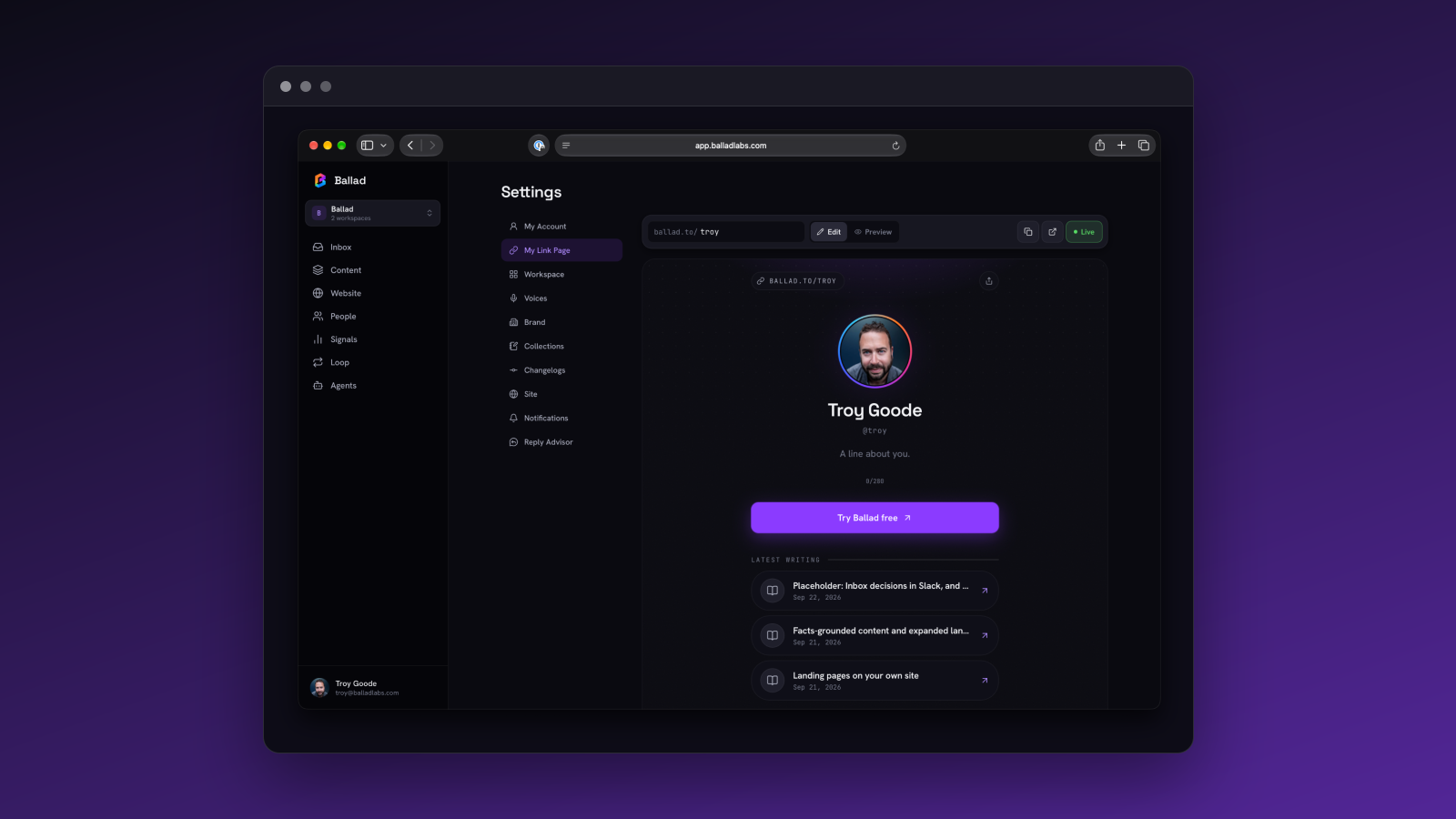
Your Link Page just got a Look button. Find it under Settings › My Link Page: pick a dark or light background, then an accent color — Ballad violet, one of your brand colors, or any custom color you want. Changes preview instantly, and the wordmark and background adjust to match whatever you pick.
Image posts get the same kind of control. In Settings › Brand, you can now write a free-text image style line, and every image post Ballad generates follows it.
And Ballad itself now follows your system's light or dark setting by default. If you'd rather it stayed put, go to Settings › My Account and force light or dark mode — the choice is saved to your account and applies instantly, even before the page finishes loading.
Workspace controls and things to know
A few changes to how the workspace itself behaves, not just what it produces.
You can now leave a workspace on your own, from the members list, instead of asking someone else to remove you. If you're the owner, you're prompted to hand off ownership first. If you're the last person left, Ballad asks you to delete the workspace instead of leaving it ownerless. Either way, whatever's already published stays published.
Approval isn't final anymore, for social posts. If you approved or scheduled one and changed your mind, you can pull it back to the Inbox for another look, which frees up its time slot, or decline it with a reason. Articles don't get this — approving an article kicks off its publish process, so that decision still sticks.
Battlecards can now leave Ballad without leaving the workspace exposed. One revocable link from the Loop's battlecards panel gives outsiders a read-only, always-current index of your competitor battlecards, print-friendly, with no app chrome around it.
On the Audit page, findings that trace back to the same underlying issue across multiple pages are now grouped into a single card, with every affected page listed, one "Copy for Agent" text for your coding agent, and a bulk action to mark all of them fixed or dismissed at once.
And onboarding finally remembers the website you typed on the sign-in page, so it starts reading it instead of asking again.
None of these are big features on their own. But taken together with business-aware content, they point the same direction: Ballad is holding onto more context about your workspace, your team, and your business between sessions, instead of treating each one as a blank slate.